
What Probate Covers in Bucks County
Probate is the legal step that proves a will and opens an estate. In Pennsylvania, this is not done by a separate "probate court." It runs through the Register of Wills and the Clerk of Orphans' Court. The Bucks County Register of Wills processes the paperwork for a person who has died, appoints a personal representative, issues Short Certificates, and handles inheritance tax filings as an agent for the Commonwealth. You can read the office's own summary on the county Probate Estates Administration page.
An estate is probated in the county where the person lived at death. So the first step is to check the death certificate and confirm the person was a Bucks County resident. If they lived elsewhere, the estate belongs in that county. The Register of Wills covers the will and estate side. The Orphans' Court side handles disputes, accountings, guardianships of minors and incapacitated adults, and adoptions.
These two roles work together but cover different ground. The Register accepts the filing and grants authority. The Orphans' Court steps in when a matter is contested or needs a judge.
Probate Terms Defined
Probate filings use words that rarely come up anywhere else. A short glossary makes the dockets and forms easier to read. These terms appear across most Bucks County estate files.
- Testator
- A person who dies leaving a valid will.
- Executor
- The person named in a will to settle the estate.
- Administrator
- The person appointed to settle an estate when there is no executor.
- Intestate
- Dying without a valid will.
- Letters Testamentary
- The authority issued to an executor named in a will.
- Letters of Administration
- The authority issued to an administrator when there is no will.
- Short Certificate
- A document that proves a personal representative's legal authority to act for the estate.
The Short Certificate matters most in day-to-day work. Banks, brokers, and other holders ask for it before they release assets held in the name of the person who died. Plan on needing one per financial institution.
How to Search Bucks County Orphans' Court Records
You can look up most probate and estate cases through the Bucks County case search portal. Open the Bucks County Web Viewer and use the Register of Wills case search. The fields match the civil portal, so you get a Search box, a Case # field, a Case Type menu, and date ranges. Results show in a grid or a simple list. Orphans' Court access is limited for sensitive matters, so not every case will appear in a public search.
Case numbers follow the XXXX-XXXXX format. When you enter a Register of Wills number, drop the 09 prefix. A name search works well when you do not have a number in hand.
- Open the Web Viewer and pick the Register of Wills case search.
- Enter a name in the Search box, or a case number in the Case # field using the XXXX-XXXXX format with the 09 prefix removed.
- Narrow the list by case type or a date range if you get too many results.
- Open the matching estate to read the docket entries and filings.
- Request a certified copy or short certificate from the Register of Wills when you need it for legal use.
Note: documents bought through the Register of Wills side of the portal can be downloaded for only a short window, so save your file as soon as the purchase clears.
Bucks County Probate Archives and Genealogy
The Register of Wills and Clerk of Orphans' Court keeps one of the deepest record sets in the state. Files date back to 1684, which makes this one of the oldest government offices in the country. Complete microfilm of the records sits at the Archive Research Center. Original Register of Wills documents from 1684 to 1936 are held on-site. Original files from the past five years are also on hand, while other originals are stored off-site and need a request in advance.
Researchers and family historians use these files often. A genealogical index search costs $25 per name for records from 1684 to 1950, and that fee is not refundable.
The county explains the request process and what is available on its Genealogical and Archival Search Requests page.
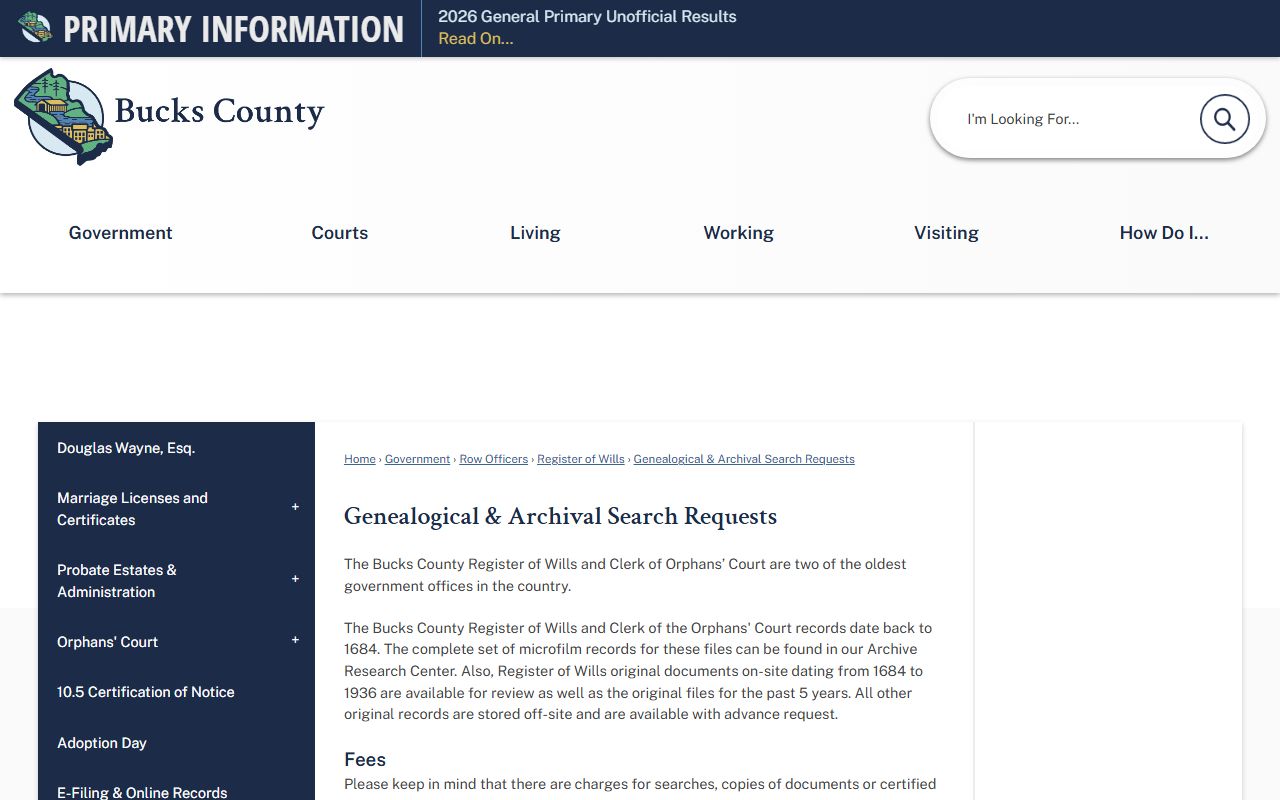
That page is the best starting point when the record you want predates the online portal or sits in the off-site archive.
How Probate Works in Bucks County
Opening an estate follows a set order. The path is the same whether there is a will or not, though the title of the personal representative changes. The steps below outline a typical Bucks County estate from first filing to close.
- Confirm the person was a Bucks County resident, using the death certificate to verify the home county.
- Find out whether there is an original will and a named executor.
- Start the Petition for Grant of Letters online through ProPublic, or in person at the Doylestown or Levittown office.
- Submit the original documents to the Register of Wills after the e-filed petition is accepted.
- Pay the Register of Wills fee, which is based on the gross probate assets.
- Receive the Letters and Short Certificates that prove your authority to act.
- Give the notices required by court rule to heirs and beneficiaries.
- Handle the inventory, inheritance tax, creditor claims, accounting, and final distribution.
Most estates move through these steps without a hearing. Contested estates, guardianships, and adoptions are the exception. Those go before the Orphans' Court for a judge to decide.
Orphans' Court Office in Bucks County
The Petition for Grant of Letters is what begins probate. You can file online by starting at the county case portal, or in person at the Doylestown or Levittown offices. After an e-filed petition is accepted, all original documents go to the Register of Wills office in Doylestown. The county provides free interpreters in several languages through Court Administration for probate appointments, so language is not a barrier to filing.
Bucks County Register of Wills and Clerk of Orphans' Court
Bucks County Administration Building
55 East Court Street
Doylestown, PA 18901
215-348-6000
The Administration Building is the main filing point for original probate documents. Call ahead if you need an interpreter or have an off-site archive request.
Probate Filing Fees
The Register of Wills charges by the size of the estate, plus set fees for common documents. The probate fee bill below took effect October 1, 2025. The estate fee is based on the gross probate assets, so a small estate pays far less than a large one. Each block of assets carries its own flat charge.
| Item | Fee |
|---|---|
| Affidavit | $25 |
| Bond & Waiver of Bond (Probate) | $25 |
| Certification (filed or issued) | $25 plus $1 per page |
| Certification of Notice (electronically filed) | No charge |
| Certification of Notice (paper filed) | $25 |
| Probate assets $0 to $5,000 | $50 |
| Probate assets $5,001 to $10,000 | $75 |
| Probate assets $10,001 to $25,000 | $125 |
| Probate assets $25,001 to $50,000 | $175 |
| Probate assets $50,001 to $100,000 | $225 |
| Probate assets $100,001 to $200,000 | $325 |
| Probate assets $200,001 to $300,000 | $425 |
| Each additional $100,000 or fraction | Add $150 |
Note: the genealogical index search is billed apart from these probate fees, at $25 per name for records from 1684 to 1950.
What Bucks County Orphans' Court Records Show
An Orphans' Court file is built around the docket, much like any other court case. The docket lists each filing and event in date order. The exact mix depends on whether the matter is an estate, a guardianship, or an adoption, but the core layout holds steady across files.
A typical estate or Orphans' Court record can include several kinds of entries.
- Docket entries that log each filing and order in date order.
- Petitions, such as the Petition for Grant of Letters.
- Decrees and orders signed by the court.
- Notices given to heirs, beneficiaries, and interested parties.
- Accountings that show what came into and went out of the estate.
- Certifications, bonds, and inventories of estate assets.
- Short certificates issued to the personal representative.
For older estates, the actual will and supporting papers may sit only in the archive. The online docket points you to what exists, even when the full document is held on microfilm or off-site.
Restricted Orphans' Court Records
Not every probate file is open online. Probate and Orphans' Court records carry limited remote access under the Case Records Public Access Policy. That covers cases under the Probate, Estates and Fiduciaries Code, along with Adult Protective Services and Older Adult Protective Services matters. For these, remote access is usually limited to dockets, orders, and opinions. The full file may still be viewed in person, but it will not stream through the portal.
Two kinds of cases carry tighter rules. Adoption records are restricted under 23 Pa.C.S. Chapter 29, which seals them from ordinary public view. Guardianship of incapacitated persons is treated as sensitive, since these files hold private medical and financial details about a vulnerable adult.
To see a restricted record, you usually must be a party, an heir, or another authorized person, or you must ask the court for access. When a file does not show online, that is by design, not an error in your search.