
Arrest Records in Bucks County
An arrest in Bucks County usually begins with a municipal police department, the Pennsylvania State Police, or the County Sheriff. After the arrest, the person is taken before a Magisterial District Judge for a preliminary arraignment. Bail is set at that hearing. If bail is not posted, the person may be committed to the Bucks County Department of Corrections in Doylestown. An arrest record reflects this early stage. It shows the booking, the charge filed by police, and the basic facts that started the case. The booking creates the first formal entry, and later events build on it.
An arrest record is not the same as a criminal court record, and neither one is a conviction. The arrest record reflects the booking and the initial charge. The criminal court record is the case docket and its disposition, kept by the court. A conviction is a separate result that only the court can enter. Bucks County does not run a public online jail roster or a mugshot gallery on its official site, so recent arrests are tracked through a phone lookup or through the court dockets. Full case history lives with the court, and the Bucks County court records page covers that side in depth.
How to Search Bucks County Arrest Records
There is no single arrest log to scroll through in Bucks County. Instead, the search splits across a phone inmate lookup and the court dockets. The official inmate lookup is an Interactive Voice Response (IVR) phone system run by the Department of Corrections at 267-915-4072. It gives bond amount, the Bucks County Corrections ID number, housing location, and visiting hours. To follow the charges and the case itself, you turn to the magisterial and Common Pleas dockets through the state court portal. Picking the right tool depends on what you need.
- Call the Bucks County Department of Corrections IVR line at 267-915-4072 to confirm whether a person is in custody and to get the bond, the Corrections ID number, housing, and visiting hours.
- Open the Pennsylvania UJS Case Search to find the matching court docket by Participant Name, Docket Number, OTN, Complaint Number, Incident Number, or Arresting Agency.
- Set the County to Bucks to trim out cases from the rest of the state, then open the docket that matches your person.
- Read the docket for the charges, grading, offense dates, bail, and any disposition entered so far.
For broader history, statewide criminal records run through the Pennsylvania State Police rather than the county. A docket pulled from the UJS portal shows charges, grading, offense dates, docket entries, bail, dispositions, sentencing, costs, and restitution. That makes it the best free way to follow a Bucks County arrest after the booking. The Bucks County court dockets page explains how to read those entries in order.
Arrest Records vs. Criminal Court Records
The two records cover different stages of the same event. The arrest record is born at booking, when police log the person and the charge. The criminal court record begins when charges are filed and the case opens in court. They are kept by different offices and they hold different facts. In Bucks County, the Clerk of Courts is the custodian of criminal court records, while the booking side runs through the Department of Corrections and the arresting agency.
| Arrest Record | Criminal Court Record | |
|---|---|---|
| Source | Police, State Police, or Sheriff | Clerk of Courts |
| Created When | Booking | Charges filed |
| Contents | Booking info, initial charge, bond, housing | Docket entries, charges, disposition, sentencing |
| How to Find | Phone IVR lookup at 267-915-4072 | UJS Case Search docket |
The Clerk of Courts, Eileen Hartnett Albillar, MSW, keeps criminal court records and juvenile delinquency and dependency records. The office uses the Common Pleas Case Management System, known as CPCMS, which is used in all 67 Pennsylvania counties. CPCMS moves data among the Magisterial District Courts, the Court of Common Pleas, and the Pennsylvania State Police. You can reach the office at 100 N Main Street, Doylestown, PA 18901, or by phone at 215-348-6389, and read more on the Clerk of Courts page.
Charges vs. Convictions
People mix up these two terms all the time, and the gap between them is large. A charge is an accusation by the Commonwealth. A conviction is a guilty plea or a finding of guilt by the court. An arrest puts a charge on the record, but it settles nothing. The disposition shows the result of each charge, whether guilty, dismissed, not guilty, or something else. Reading the disposition is the only way to know how a case ended.
| Charge | Conviction | |
|---|---|---|
| Stage | Accusation by the Commonwealth | Guilty plea or finding of guilt |
| Who Decides | Police and prosecutor | The court |
| Shown By | The filed charge | The disposition |
| Final? | No, the case is still open | Yes, the charge is resolved |
Diversion can also change how a case ends. Bucks County runs the Recovery Court, along with a Wellness Court and a Veterans Treatment Court. These programs can change how a criminal case is resolved, and the disposition will reflect that path.
Here is a look at the Recovery Court, one of the diversion programs that can reshape a charge.
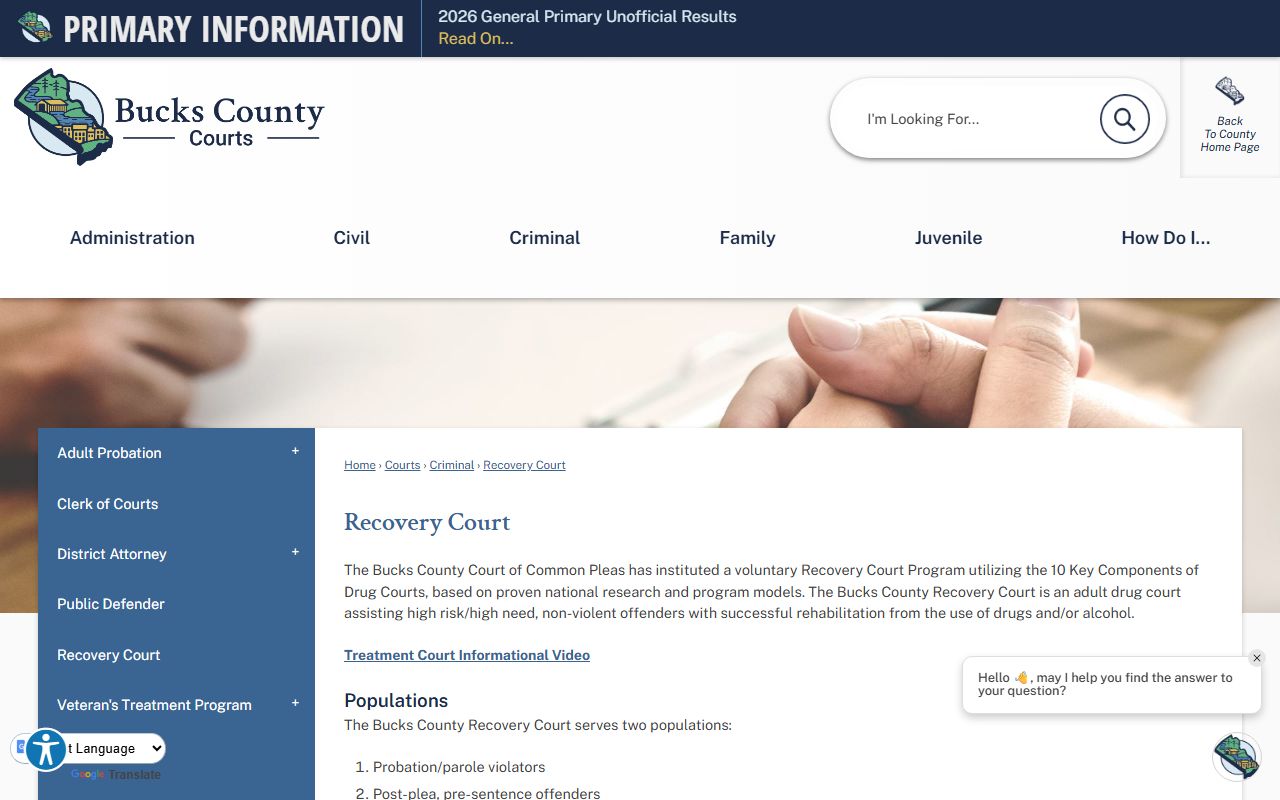
A case routed through Recovery Court may end with a different disposition than a standard prosecution, so the docket is worth a close read.
Sealed vs. Expunged Records
Pennsylvania uses two main tools to clear or hide a criminal record, and they are not the same. Expungement removes eligible criminal history under 18 Pa.C.S. § 9122. Limited access seals a record from ordinary public view while still keeping it available to the courts and the police. Sealing can happen by petition under 18 Pa.C.S. § 9122.1, or automatically through the Clean Slate process under 18 Pa.C.S. § 9122.2. Clean Slate comes from Act 5 of 2016. Knowing which path fits a record matters, since the two lead to very different results.
| Sealed | Expunged | |
|---|---|---|
| Visibility | Hidden from ordinary public view | Removed from the record |
| Law Enforcement | Courts and police keep access | Very limited access |
| How It Happens | Petition or automatic Clean Slate | Petition for eligible history |
| Governing Law | § 9122.1 and § 9122.2 | § 9122 |
All of these rules sit inside one law. The governing statute is the Criminal History Record Information Act, found at 18 Pa.C.S. Chapter 91. It sets the framework for how criminal history is kept, shared, sealed, and expunged across the state.
The act, often called CHRIA, is the backbone for how Bucks County arrest records are handled.
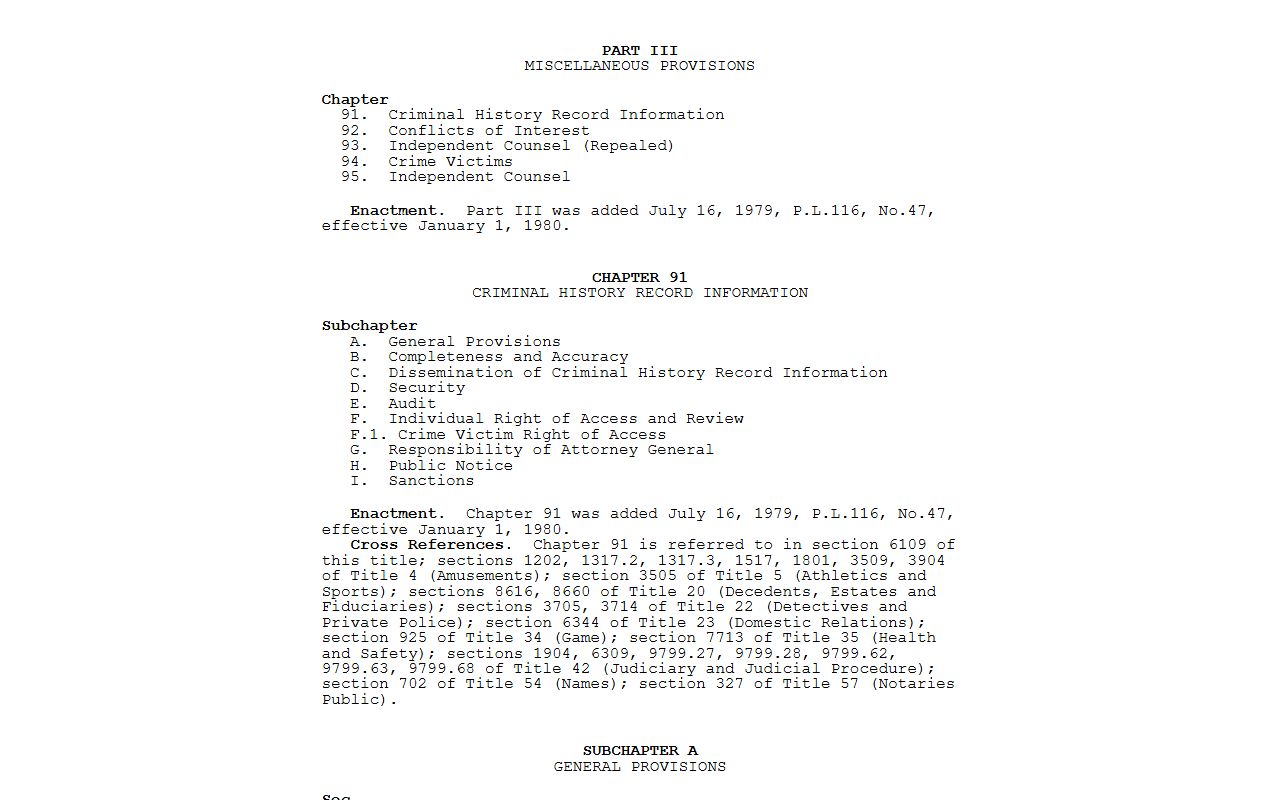
Reading the statute helps explain why some old arrests stop showing up in a public search once they qualify for Clean Slate.
Mugshots and Booking Photos
Bucks County does not post mugshots or booking photos online. There is no official mugshot gallery on the county site, and no public photo feed of recent arrests. This trips up people who expect a scrolling page of booking photos. The county keeps the booking side behind its phone lookup instead.
To confirm a booking, you use the Department of Corrections IVR line at 267-915-4072. It tells you the bond, the Corrections ID number, housing location, and visiting hours. It does not hand out a photo. For the charges and the case itself, the court dockets are the better trail, and you can pull them through the state portal. Recent arrests are best tracked through that phone lookup or through the magisterial and Common Pleas court dockets.
Statewide Criminal Records Search
Some searches reach past the county. Statewide criminal records flow through the Pennsylvania State Police, which receives case data through CPCMS as cases move from the magisterial courts up to the Court of Common Pleas. That is the same system the Clerk of Courts uses, so a Bucks County arrest feeds into the statewide picture. The State Police hold the central repository for criminal history across Pennsylvania.
One public statewide tool is the sex-offender registry. The Pennsylvania Megan's Law registry lists registered offenders and is open to the public. It is separate from a general criminal history search, but it is a common starting point for people checking a name. For full case files tied to a specific arrest, the UJS Case Search remains the main free route. You can search it by Arresting Agency, OTN, or Participant Name, among other fields.
Background Check Considerations
An arrest is not a conviction, and that point shapes how you should read any result. A name may show an arrest with no conviction at all. Expunged records should not appear in a search, and limited-access records should be hidden from ordinary public view. So a clean docket does not always mean a person was never arrested, and an old charge does not always mean a conviction followed. Read the disposition before drawing any conclusion.
Formal background checks follow stricter rules. A check used for employment, tenant screening, or credit falls under the federal Fair Credit Reporting Act, known as the FCRA. Those checks must run through a regulated consumer reporting agency that follows the law. A casual public-record lookup is not the same thing and cannot stand in for an FCRA-compliant report.
Important: Public arrest and court records pulled outside a regulated agency are not FCRA-compliant, so they may not be used for employment, tenant, or credit screening.
Restricted Criminal Records in Bucks County
Not every arrest record is open to the public. Several categories are restricted by law or by court rule. Juvenile files are limited under 42 Pa.C.S. § 6307 to a short list of judges, parties, and agencies. Expunged cases are removed from the public record. Limited-access cases sealed through petition or Clean Slate are hidden from ordinary view. Mental-health treatment records are also kept out of the public file.
You can read the juvenile records rule at 42 Pa.C.S. § 6307. To get help clearing a record, the county Public Defender can assist. Niels C. Eriksen Jr. leads the office at 100 N Main Street, 1st Floor, Doylestown, reachable at 215-348-6473, and the office handles expungement and pardons help. You can read more on the Public Defender page.
Prosecution sits on the other side. District Attorney Joe Khan, sworn in January 5, 2026, leads the office at the Bucks County Justice Center, 100 N Main Street, Doylestown, at 215-348-6344.
The Public Defender office is the place many people start when they want to seal or expunge an old arrest.
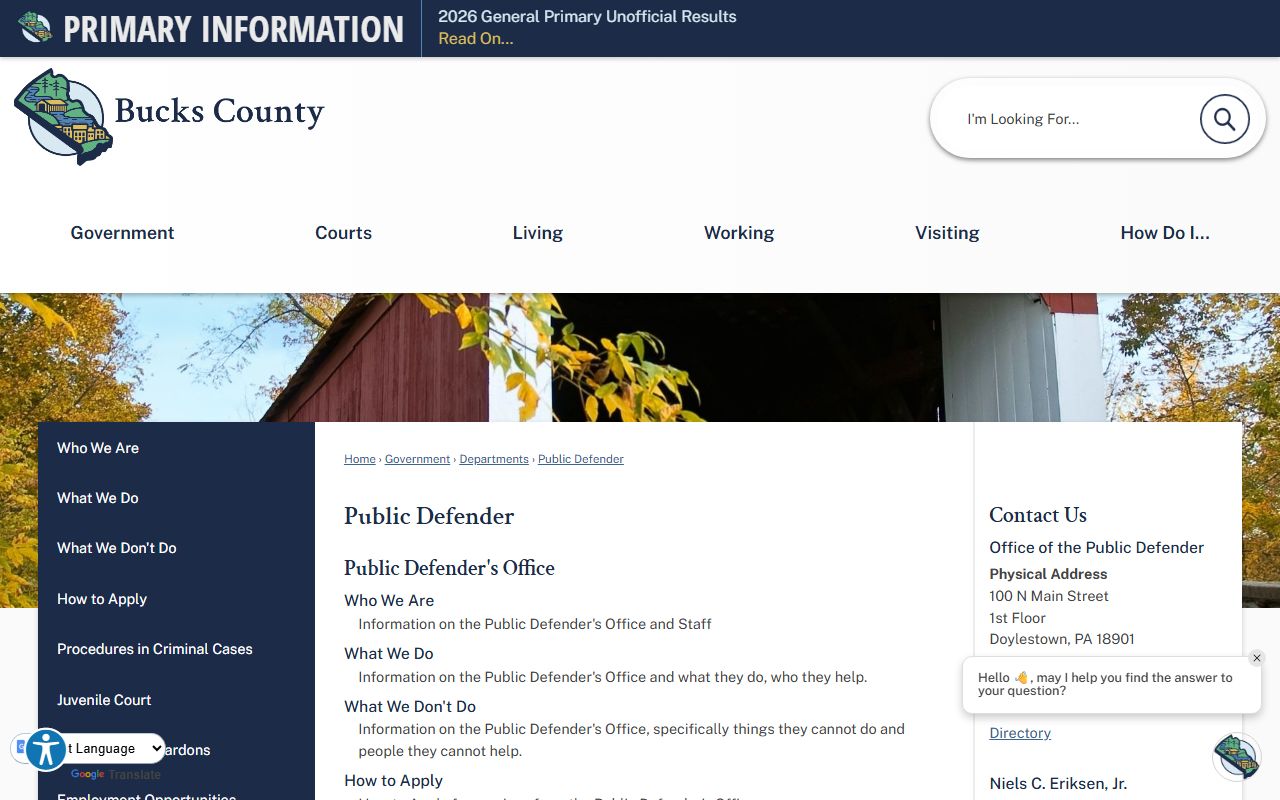
An eligible record can be sealed or cleared with the right petition, which changes what later shows up in a Bucks County arrest search.