
About the Bucks County Clerk of Courts
The Bucks County Clerk of Courts is the official custodian of the county's criminal court records. The office also keeps juvenile delinquency and dependency court files. Eileen Hartnett Albillar, MSW, serves as the current Clerk of Courts. The office sits inside the Bucks County Justice Center in Doylestown, the same building that houses the trial court and the other filing offices. Anyone can contact the office to ask about a criminal case, a court cost balance, or a certified copy.
The office states its mission plainly. It works to keep the integrity of the county's criminal records, to support the courts, and to treat the community with respect. It also assesses, collects, and distributes the monies due in criminal cases. That money side is a large part of the daily work. Court costs, fines, fees, and victim restitution all flow through this office, and the staff make sure the right party gets paid.
It helps to know the line between this office and the others. The Clerk of Courts owns the criminal record. It does not hold civil suits, divorce files, or wills. Those go to the Prothonotary and the Register of Wills. So a person looking for a criminal case file, a sentencing order, or a restitution balance starts here. A person chasing a divorce decree or an estate starts elsewhere. Getting that right on the first try saves a wasted trip to the wrong window.
Bucks County Clerk of Courts
Clerk: Eileen Hartnett Albillar, MSW
100 N Main Street
Doylestown, PA 18901
215-348-6389
Fax: 267-885-1371
What the Clerk of Courts Does in Bucks County
The Clerk of Courts handles the criminal side of the county court system. It accepts filings, keeps the case files, and tracks each case from charge through sentencing. The office runs on the Common Pleas Case Management System, known as CPCMS. This is the same system used in all 67 Pennsylvania counties. CPCMS moves case information among the Magisterial District Courts, the Court of Common Pleas, and the Pennsylvania State Police, so a case stays linked as it travels through the system.
Money is the other half of the job. The office assesses, collects, and disburses restitution, court costs, fines, and fees. In 2025 it disbursed $2,799,703.59 in restitution to crime victims. It sent $1,606,446.54 to the Pennsylvania Department of Revenue and $5,507,368.16 to Bucks County. Those numbers show the scale of what passes through the office each year.
The core duties break down like this.
- Keep and protect the county's criminal court records and juvenile court files.
- Accept criminal filings and process them through the CPCMS case system.
- Assess and collect court costs, fines, fees, and victim restitution.
- Disburse the money due to victims, the state, and the county.
One program stands out. DRiP, the Delinquency Recovery Program, started in 2020. It collects unpaid court costs, fines, fees, and victim restitution from people who fell behind. Payment plans can be set up or reset by calling 215-340-8037. As of March 2026 the program had recovered more than $3 million, money that goes back to victims and the public.
How to Request a Certified Copy
A certified copy is a court document the office has stamped and signed as a true copy. People need them for many reasons. A lawyer may need one for a hearing, an employer may ask for proof of a disposition, and an immigration filing often calls for a certified record. A plain printout from a docket search will not carry the same weight. For legal use, the certified copy is what holds up.
- Find the criminal case first. Use the docket number, or search by the defendant name through the Pennsylvania UJS Case Search.
- Contact or visit the Clerk of Courts at 100 N Main Street in Doylestown, and ask for the right request form.
- Complete the form. List the document you need and the case it belongs to.
- Pay the fee shown on the Clerk of Courts fee bill, and ask the staff to certify the copy.
- Include a Certificate of Compliance for any paper filing, since the access policy requires it.
The docket search runs through the state portal, but the office itself is the official custodian of the record. You can start a docket lookup on the Pennsylvania UJS Case Search, then bring the docket number to the office for the certified copy.
Plan ahead for the cost. The fee depends on the document and the number of pages, and certification adds its own charge. Both are set on the office fee bill. If the case is closed and you only need to confirm an outcome, a free docket view from the state portal may be enough. Save the certified copy for a court, an agency, or an employer that will not take a plain printout. The office can tell you which the matter calls for if you are unsure.
Records Request Form Fields
A clean request moves faster. The office needs enough to find the exact case and the exact document, plus payment. Give the docket number when you have it. If not, the defendant name will let staff look up the case. The table below shows what a criminal records request should include.
| Field | Required | Notes |
|---|---|---|
| Defendant Name or Docket Number | Yes | A docket number is fastest; a defendant name works when you lack a number. |
| Document Needed | Yes | Name the exact filing, order, or disposition you want. |
| Certificate of Compliance | For paper filings | Required for paper-filed criminal documents under the access policy. |
| Payment | Yes | Pay the amount set on the Clerk of Courts fee bill. |
Note: A certified copy carries the office stamp; a plain copy does not, so name which one you need on the form.
Bucks County Clerk of Courts Fees
Fees for criminal records are set on the office's published schedule. The Clerk of Courts page links a document called the Fee Bill 2026, which lists the current charges. Copy and certification costs change from year to year, so the fee bill is the right source to check before you pay. The table below points to that schedule rather than listing dollar amounts that may shift.
| Item | Amount |
|---|---|
| Criminal record copies | See the Clerk of Courts Fee Bill 2026 |
| Certification | Per the Fee Bill 2026 |
| Restitution, costs, and fines | Pay through a DRiP plan by calling 215-340-8037 |
If you owe court costs, fines, or restitution on a case, the office can set up or reset a payment plan through DRiP. That keeps a case in good standing and routes restitution back to the victim. The current schedule and contact details sit on the office's Clerk of Courts page.
Common Clerk of Courts Forms
The office posts the forms used most often in criminal and juvenile matters. They cover bail, appearance, address changes, property returns, and appeals from the minor courts. The office also links an Expungement section, which points to the state law on expungement at 18 Pa.C.S. § 9122. The list below names the forms the office makes available.
- Application for Bail Piece and Assignment of Bail
- Certificate of Compliance, required for paper-filed criminal documents
- Change of Address Form and Entry of Appearance for criminal, dependency, and juvenile cases
- Motion for Return of Property and Motion to Proceed In Forma Pauperis
- Notification of Judgment, Nunc Pro Tunc Petition, and Stop Payment Form
- Summary Appeal Form and Waiver of Arraignment
You can find the full form list and the Expungement section on the office's Frequently Requested Information page.
Mail and Online Filings
The Clerk of Courts is the custodian of criminal records, but the public docket search runs through the state portal. You can look up a Bucks County criminal case from anywhere on the Pennsylvania UJS Case Search. The portal shows the docket, the parties, and the case status. For a certified copy or a paper filing, the office itself is the place to go, by mail or in person.
Paper filings carry one firm rule. A Certificate of Compliance is required for paper-filed criminal documents under the Case Records Public Access Policy. That form states the filing does not include confidential information that should be kept out of the public record. Skip it, and the office may reject the paper.
The county gathers the contact details, the fee bill, and the forms on a single page for easy reference.
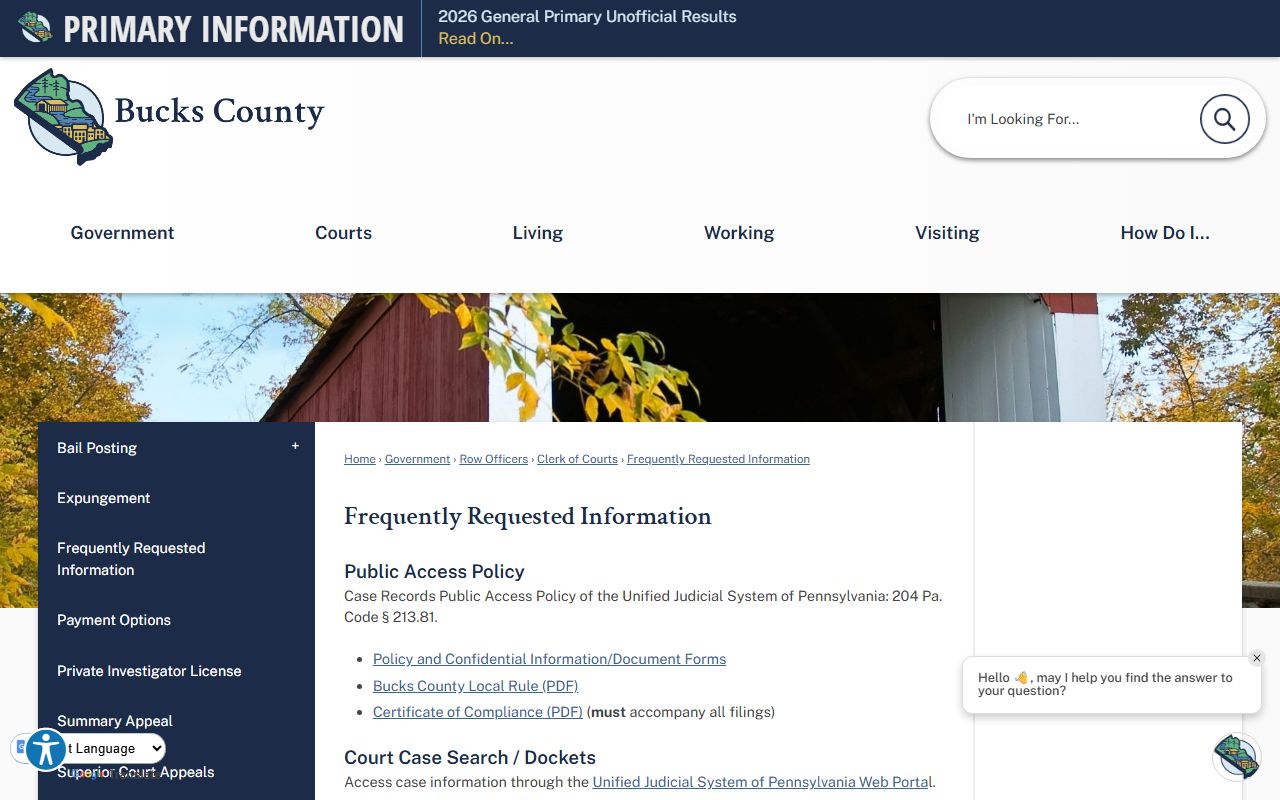
The Frequently Requested Information page lists what you need before you mail or visit, so it is worth a look first.